AI Security in the UAE

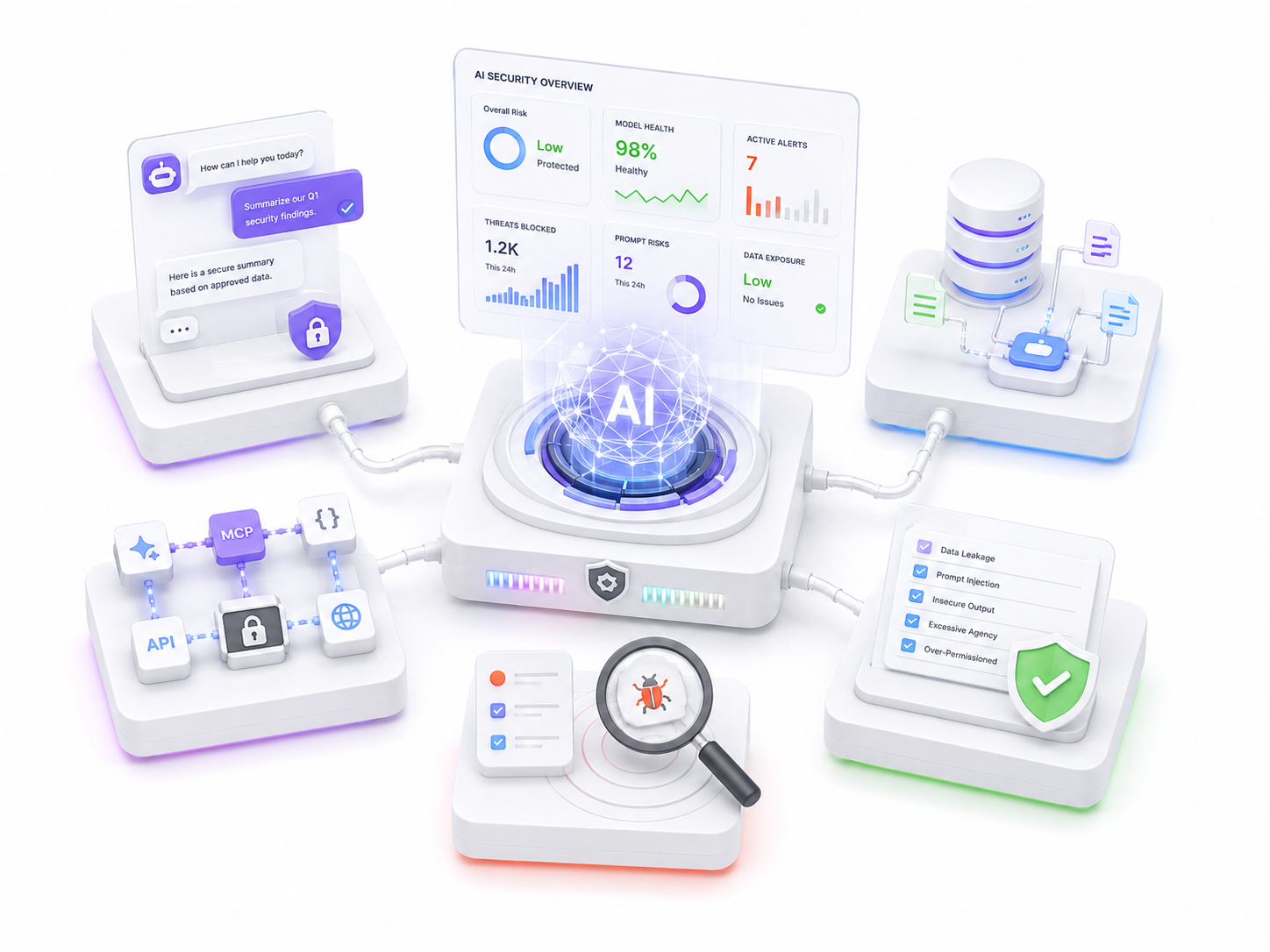
Organisations are wiring AI into core processes faster than they’re securing it. ChatGPT Enterprise, Copilot, Claude, custom RAG pipelines and autonomous AI agents that act through tool-calling and the Model Context Protocol (MCP) now process sensitive data, make decisions and reach into internal systems. The same flaws that lived in web applications a decade ago now live in LLM and MCP integrations — often with greater impact.

Rootsec delivers AI Security as a technical service: we test, assess and advise on the security of AI systems, LLM integrations and MCP services. No consultancy talk — concrete findings with working proof-of-concepts you can actually fix.

Book a Strategy Call

AIPentesting

What is AI Security?

AI Security is the set of measures that protect AI systems against abuse, manipulation and data leakage. It differs from traditional cybersecurity in three ways:

  • Attack surface — an LLM accepts natural language as input. Every user, every document and every external source is a potential attack vector.
  • Non-deterministic behaviour — the same system responds differently to the same input. Classic test methods fall short.
  • Leakage through the model itself — training data, system prompts and connected tools leak via prompt injection, not via a vulnerable endpoint.

The key risk categories are documented in the OWASP Top 10 for LLM Applications, the MITRE ATLAS framework and the NIST AI Risk Management Framework. Rootsec uses these as the basis for our testing methodology. Concrete examples of what goes wrong:

  • An employee pastes customer data into Copilot, and that data becomes part of a shared context.
  • A RAG chatbot retrieves a malicious document and executes hidden instructions (indirect prompt injection).
  • An AI agent with email access is abused to send phishing on the organisation’s behalf.
  • A custom GPT leaks its system prompt — including API keys and internal instructions.
  • An AI agent with tool-calling performs actions in another user’s or tenant’s context via a confused-deputy attack.
  • An LLM integration in a customer portal is jailbroken to access other customers’ data.

What types of AI Security are there?

LLM Penetration Testing

Technical testing of AI applications, chatbots and custom GPTs based on the OWASP Top 10 for LLM Applications and the MITRE ATLAS framework. Focus on prompt injection, data leakage, insecure output handling and model denial of service.

AI Red Teaming

Adversarial testing of production AI systems, including agentic AI and MCP integrations. Goes beyond a pentest: jailbreaks, model extraction, training-data inference and the abuse of AI agents that reach internal systems via tool-calling.

Secure AI Implementation

Secure rollout of Copilot, ChatGPT Enterprise, Claude and Gemini across your organisation. Review of data flows, tenant isolation, MCP connections, DLP policy and logging. Prevents staff from unintentionally leaking sensitive data through AI tools.

AI-Powered Defense

Deploying AI within detection and response platforms: AI-driven XDR, automated threat hunting and anomaly detection across log data.

AI Governance & Compliance

Meeting regulation such as the EU AI Act, the NIST AI Risk Management Framework and ISO/IEC 42001 — plus UAE data obligations under the PDPL. Includes AI inventory, risk classification and policy development.

AI Supply Chain Security

Assessment of external AI components: third-party models, APIs (OpenAI, Anthropic, Google), MCP servers, open-source models from Hugging Face and AI plugins. Focused on risks such as model poisoning, malicious models and vendor dependency.

Book a Strategy Call

Types of AI Security tests

Discover how our chatbot, RAG and agent tests identify and address vulnerabilities to better protect your AI integrations against abuse and data leakage.
Chatbot & Custom GPT Testing

We focus on AI assistants that interact directly with end users, testing for prompt injection, jailbreaks, system-prompt leakage and manipulation of bot behaviour. Perfect for checking whether your customer-service bot, internal assistant or custom GPT can withstand abuse.

RAG Pipeline Testing

We target AI systems that consult external documents or data sources to generate answers, examining indirect prompt injection via documents, unintended exposure of internal data and manipulation of search results. Essential for any organisation surfacing internal knowledge through an AI layer.

AI Agent & Tool-Calling Testing

Deep insight into AI systems that act autonomously via tool-calling or MCP: sending emails, calling APIs or executing code. We test for excessive agency, tool abuse, confused-deputy attacks, privilege escalation via tool parameters, cross-tenant data leakage in multi-tenant SaaS, and resource abuse. Ideal for organisations running AI agents or MCP integrations in production.

Book a Strategy Call

Step-by-step process

What we test in AI Security
Step 1
Input & prompt attacks

The single biggest risk for any AI system that processes user input. We test for prompt injection (direct and indirect via external sources), jailbreaks that bypass safety guidelines, and manipulation of system prompts. In practice: can an attacker make your chatbot ignore its instructions, leak sensitive data, or perform unwanted actions on your behalf?

Step 2
Data & output leakage

AI systems leak information in ways traditional security doesn’t detect. We test for unintended exposure of training data, system prompts and internal documents via RAG pipelines. We also examine insecure output handling — where an LLM’s output is passed directly to other systems and triggers code execution, XSS or SQL injection.

Step 3
Agent & integration abuse

AI agents with access to email, files, APIs or internal systems via tool-calling or MCP are a new class of attack vector. We test the full chain — from user input through the LLM to the called tools and back — for excessive agency, confused-deputy scenarios, authorisation bypass, cross-tenant access, supply-chain risks from external models and plugins, and denial of service through resource-intensive prompts.

Book a Strategy Call

Why choose Rootsec for AI Security?

Rootsec is an independent pentest firm with deep technical knowledge of LLMs, AI integrations, MCP services and modern attack vectors against agentic AI and tool-calling architectures. We don't deliver a generic checklist or a consultancy report — we deliver concrete findings with working proof-of-concepts, risk classification under CVSS v4.0, and a retest after your fixes are in place, all tailored to how your organisation actually uses AI.
Security specialist running command-line tools on a Kali Linux workstation

Who benefits from AI Security?

Organisations that use AI tools for customer interaction, internal processes or decision-making — especially where sensitive data is involved or where regulation such as the EU AI Act applies. AI Security is essential to find vulnerabilities in chatbots, custom GPTs, RAG pipelines and AI agents before attackers exploit them. Choose Rootsec to keep your AI integrations secure, compliant and under control.

Rootsec: a leader in AI Security

At Rootsec we understand that every AI implementation is unique. A custom GPT for HR demands a different approach than a RAG chatbot in a customer portal or an agent with access to internal systems. Our AI Security engagements are therefore fully tailored — so we not only identify vulnerabilities, but also deliver concrete solutions that fit your specific architecture. Choose Rootsec and experience the difference between generic AI audits and genuine technical depth.

Book a Strategy Call

Frequently asked questions

Helpful answers about AI Security and Rootsec
What makes Rootsec different from other AI Security providers?

Rootsec tests AI systems with the same technical depth as a classic pentest, but focused on LLMs, RAG pipelines, agentic AI and MCP integrations. We’re independent, we deliver working proof-of-concepts rather than theoretical checklists, and we combine our pentest experience with up-to-date knowledge of AI attack vectors such as prompt injection, tool-calling abuse and confused-deputy attacks.

How often should my organisation run an AI Security test?

At least once a year, and after any major change to your AI environment — a new model, expanded system prompts, new tool integrations, added MCP servers or changes to the authorisation layer — so new vulnerabilities are caught and fixed in time.

Which businesses benefit from AI Security?

Any organisation that uses AI tools for customer interaction, internal processes or decision-making. This is especially true for SaaS platforms with AI functionality and MCP integrations, and for sectors such as financial services, healthcare, education, government and IT — as well as businesses rolling out Copilot, ChatGPT Enterprise or their own chatbots securely.

What exactly does an AI Security test involve?

A simulated attack on your AI systems to uncover vulnerabilities. Our experts test prompt injection (direct and indirect), data leakage, jailbreaks, insecure output handling, tool-calling abuse, confused-deputy attacks and authorisation bypass, and deliver a clear report with concrete recommendations to strengthen your AI and MCP integrations.

What can I expect from the report after an AI Security test?

An overview of the vulnerabilities found, including risk classification under CVSS v4.0, impact and working proof-of-concepts. You also receive concrete recommendations and a prioritised action list, followed by a retest after your fixes are in place.

Latest from our blog

Deploying AI? Make sure it's secure. Get in touch for expert support.

By submitting this form, I agree to the General Terms & Conditions and the Privacy Policy.