The short answer
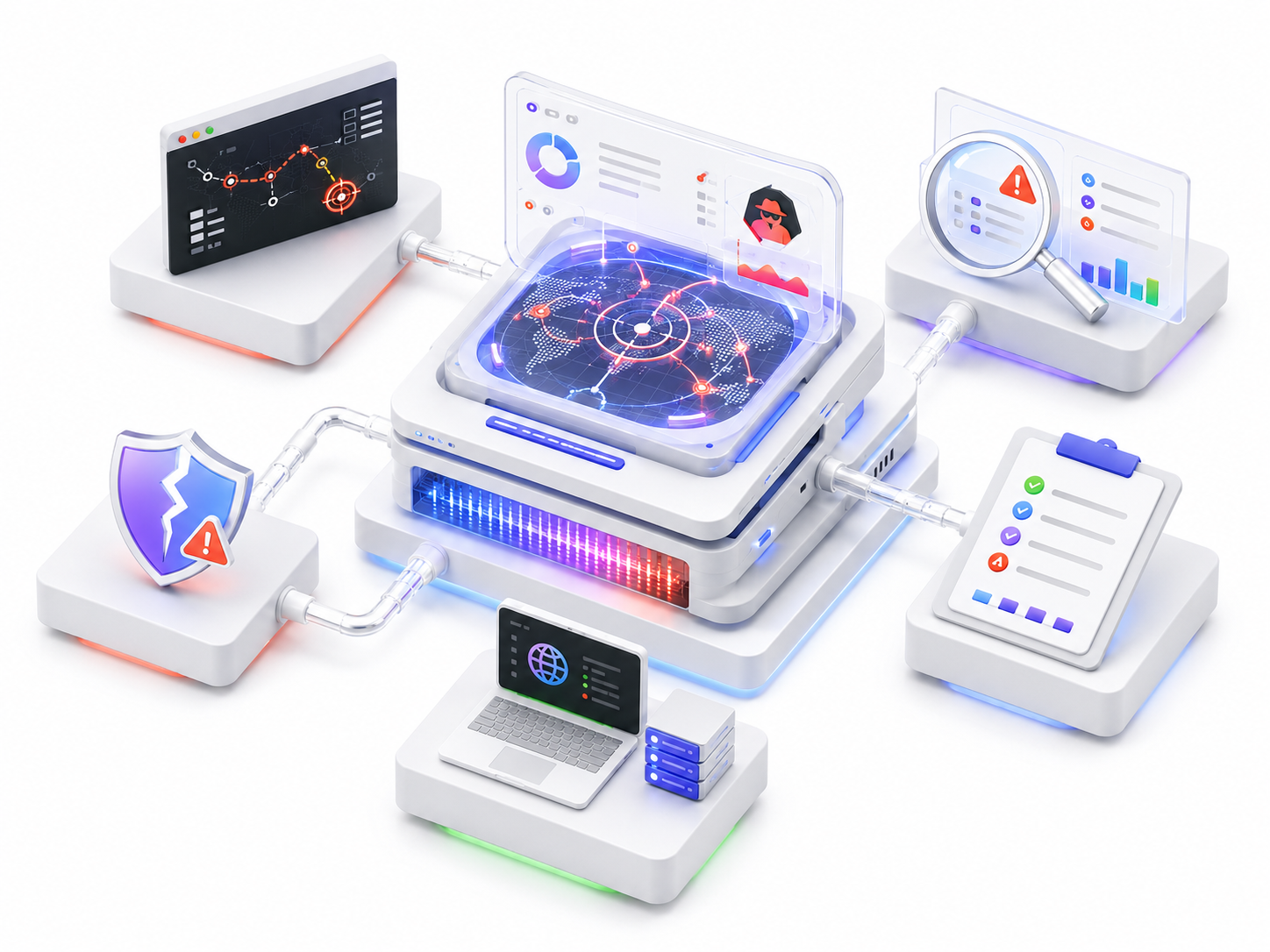
A fintech red team is a goal-based attack simulation: we start outside your company, with no access, and try to reach an objective you choose, such as the production environment, the card platform or customer funds. We use the same routes real attackers use against payment firms: social engineering, stolen sessions, exposed services and weak links between office IT and the cloud. You get proof of what worked, what your team detected and what to fix first.
Why fintechs are a different target
A fintech is small in headcount and large in consequence. A few dozen engineers hold the keys to systems that move money, and most of the company runs on cloud consoles, single sign-on and a deployment pipeline. An attacker does not need to break your payment application if one engineer’s laptop or session opens the same door.
That is why a scan or a standard penetration test does not answer the board’s real question. A pentest tells you which vulnerabilities exist in one system. A red team tells you whether a determined attacker can chain small weaknesses, across people and technology, into access that matters.
The attack path we test
Every engagement is built around your own objective. A typical path for a UAE fintech looks like this:
- Reconnaissance. We map what an outsider can learn: staff, roles, technology, exposed services and leaked credentials.
- Initial access through people. Targeted phishing, phone pretexts and impersonation aimed at the employees an attacker would pick. See our social engineering assessment and phishing simulation for the standalone versions.
- Initial access through technology. Internet-facing applications, remote access, forgotten test systems and third-party integrations.
- Foothold and escalation. From one account or device to more privileges: identity provider, endpoint management, internal tools.
- The step to production. Cloud accounts, deployment pipelines, secrets and admin panels. This is where office access becomes business risk.
- Proof of objective. We demonstrate that the goal was reached with an agreed, harmless marker. We never move funds and never touch real customer data beyond what is needed as evidence.
Throughout, we record what your monitoring and your team noticed, and how long it took. That detection timeline is often the most valuable part of the report.
What the UAE rules say about testing
Regulators in the UAE do not prescribe a red team for every fintech, but security testing that includes the human side is written into the rules. In short:
| Regime |
Who it covers |
What it says about testing |
| CBUAE Retail Payment Services and Card Schemes Regulation, Article 13 |
Payment service providers with a monthly average transaction value of AED 10 million or more |
Must regularly assess the need for “penetration and cyber-attack simulation testing”. The scope covers networks, applications and social engineering. |
| CBUAE Stored Value Facilities Regulation, Article 12 |
SVF licensees |
The same testing wording, without the AED 10 million threshold. Applicants also file an independent assessment of technology risk and payment security. |
| CBUAE Operational Risk Management Regulation (2026), Articles 7.13 and 7.14 |
Licensed financial institutions |
Periodic testing of controls, including controls that rely on people. For critical functions: penetration testing by an independent third party, reported to the board. Check with your compliance team how this applies to your licence. |
| DFSA (DIFC), GEN 5.5.15 |
Authorised firms in the DIFC |
A testing programme for IT systems; internet-facing systems tested at least once a year; findings prioritised and fixed. |
| FSRA (ADGM), GEN 3.5.14 |
Authorised firms in ADGM |
A comparable annual testing rule. FSRA guidance names phishing exercises on staff and intelligence-driven red teaming as good practice. |
| PCI DSS v4.0.1, requirement 11.4 |
Anyone storing, processing or transmitting card data |
Internal and external penetration tests at least every 12 months and after significant changes, by a qualified, independent tester. |
At the time of writing, no UAE regulator has published a threat-led red teaming framework comparable to TIBER-EU or CBEST. In practice that means you set the scope yourself, and a well-documented red team is strong evidence when a regulator, a banking partner or an investor asks how you test your defences.
Last reviewed: November 2026. This is a summary for orientation, not legal advice. Sources: the CBUAE Rulebook, the DFSA Rulebook and the FSRA Rulebook. More detail in our comparison of NESA, DESC and CBUAE testing requirements and our PCI DSS guide.
Red team, penetration test or assumed breach?
Not every fintech should start with a full red team. The right first step depends on where you are.
|
Penetration test |
Assumed breach |
Full red team |
| Question it answers |
Which vulnerabilities exist in this application or environment? |
If one employee is compromised, how far does the attacker get? |
Can an outsider get in, reach the objective and stay unnoticed? |
| Starting point |
A defined scope with access |
A standard employee laptop or account |
Nothing: the outside world |
| Tests your people |
No |
Partly |
Yes, including social engineering |
| Tests detection and response |
Rarely |
Yes |
Yes, from the first step |
| Best moment |
Before launch, after major changes, for compliance |
When time is limited or as a first exercise |
When the basics are in place and you want the real answer |
Many fintechs combine them: an assumed-breach track runs alongside the external attack, so you still learn what happens after a compromise if your perimeter and your people hold. Read more in red teaming vs penetration testing.
How an engagement runs
- Objectives and rules of engagement. Together we define the goal, what is off limits (for example live payment processing) and who inside your company knows about the exercise.
- A small control group. A few people on your side stay informed, with a direct line to our team and an agreed way to pause the exercise at any moment.
- The operation. Typically several weeks, at the pace of a real attacker, with regular updates to your control group.
- Report and replay. A management summary for the board, the full attack path with evidence, the detection timeline and prioritised fixes. We walk your security and engineering teams through each step so they can see what to look for next time.
- Retest. We verify that the important fixes close the path.
Everything is covered by a written authorisation and a non-disclosure agreement before we start. Rootsec works from Business Bay, Dubai, and findings are shared only with the people you name.